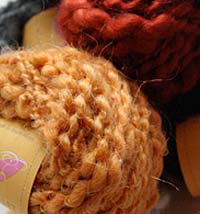
Make this hat with One Skein of Yukon!
See all Yukon Patterns & Knitkits
Mohair Yarn Knit Kits
Mohair Tassle Trimmed Hat Includes yarn and free Pattern
$7
Mohair Roll Neck Kids
Sweater & Knit Kit Includes yarn and free pattern
$29-53
What is Mohair, anyway?
Mohair comes from the Angora Goat
Characteristics:
Natural, Animal Fiber
Lustre
Non-flammable
Very durable
Washable
Wrinkle and stretch-resistant
Soil-resistant
Absorbent
Easy to dyeEnd Uses:
Mohair is the wool from the angora goat. It is a silky, lusterous, versatile and durable fiber often used to make apparel such as, coats, suits, dresses, sweaters, accessories, loungewear, and socks. Miscellaneous items include: hair for dolls, beards for Santa Claus figures, blankets, upholstery, draperies, carpets and rugs.
TYPES OF MOHAIR
Kid Mohair fleece is the first shearing from a young angora goat. It is very fine and soft handling. Fineness ranges from 23-27 microns with a staple length of 100 to 150mm.
Goatling is the second shearing from a goat and is also fine and soft. Fineness ranges from 27-30 microns with a staple length of 100-150mm.
Adult Mohair is the fleece from the mature goat. It is fine to coarse with a fineness of 30 microns onwards and the staple length is also 100-150mm.SPINNING MOHAIR
Spinning mohair is similar to spinning angora or merino wool. One can spin a soft, lofty yarn with plenty of elasticity with these following tips:
card only when blending colors
use a light tension on the wheel
put more twist into the singles to keep the yarn strong when it is plied
Mohair yarn - Where does it come from?
Where does mohair come from - from the Angora goat of course. This breed originated in the province of Ankara (Angora) in Turkey many centuries ago. Indeed, the word ?Mohair? comes from the Arabic word ?Muhayyar? which when translated means ?material from goat hair?. The first evidence of the angora goat dates back to the fourth millennium before Christ. Since that time the breed has been carefully refined so that today it yields a soft, fine yet extremely strong fibre perfect for pile fabrics.
Angora Goats
Angora goats are very temperature-sensitive animals which need to be reared under precise climactic conditions -- summers that are not too hot -- which would cause their pastures to dry out -- and winters that are not cold-- which would lead to a decimation of the herds through disease and lack of food.
The ideal conditions for angora goats are found primarily in 3 areas, namely South Africa, Turkey and Texas in the United States. However, Angora goats are now increasingly being reared in other parts of the world - for example in 2000 Australia and New Zealand each produced 3% of the entire world production of mohair
In its natural state the fur of the Angora goat is white, curly and shiny. A typical angora goat gives up to 4 kg of fleece per year in 2 shearings (once in summer, once in winter). Mohair fleece is classified into 3 grades. The first and most expensive class is kid mohair. As you would expect, kid mohair is extremely soft and fine with a fibre thickness of 24-29 microns. The next class comes from young goats and usually has a fibre thickness of between 30-33 microns. And finally the third class is fleece from adult goats with a thickness of 34-40 microns.